

“In my opinion, you cannot say you have thoroughly seen anything until you have a photograph of it.” — Émile Zola
One of the best things a witness to “The Impossible” can do to support and chronicle their UAP experience is to document the experience with a photograph or video. It’s a good bet, of course, that most anyone who’s photographed a flying saucer would say, “It’s easier said than done.”
Usually, the Phenomenon appears as a relatively small object that stands out from the sky or clouds for some reason — as a bright shining light, or as a flash reflection, or from odd maneuvers as it travels across the sky. The experience typically lasts under 60 seconds — one minute.
Unless a camera is ready, even professional and dedicated amateur photographers usually won’t have sufficient time to get serious gear set up to photograph, film, tape or record digitally. The object also can appear so mesmerizing that it becomes difficult to take one’s eyes off it long enough to find a camera before the thing moves off. It is not impossible to get the image, however.
Images of Things Unknown
The Residium has detailed the historic images taken in 1950 by Paul and Evelyn Trent in McMinnville, Oregon; the amazing series by Almiro Baraúna, on assignment to the Navy of Brazil during the International Geophysical Year of 1958 off Trindade Island; and the remarkable Polaroid images created by Rex Heflin, a California government employee on official duty in 1965.
Their photographs are among the best images of UFOs in the public domain. The images have been judged by experts in photo analysis made in the manner the witnesses reported they took them. They show what the witnesses reported seeing. What’s more, although the subject of debunking by “experts” from the day each was published, the Trent, Baraúna and Heflin photographs have withstood the test of time — plus all attempts at duplication through trickery.
Be Prepared, Scout
If you are interested in the Phenomenon, be ready to use your camera. Most UAP sightings are of some thing that usually is far off, making for a picture of what appears as a teeny tiny dot set against the big sky.
Fortunately — photographically, if not socially — we today have the cell phone. While not on the same level optically or technically as pro gear, our smart phones are capable of recording and preserving something from the phenomenon experienced. And while it may not match exactly what was seen by eyewitnesses or recalled by human minds, the photo or file backs up a report with solid information.
Whether a cell phone or a professional Digital Single Lens Reflex, a photo can also provide data that human eyes may have missed — even in cases where the photo does not resemble what the witness remembered. And while a photographic image is not probative, it serves as evidence in support of eyewitnesses.
Think beforehand of what you need to do and practice, should the opportunity present itself to take a photo. Be familiar your camera and its operation, know how to adjust settings, such as a telephoto zoom function, and practice quickly getting your camera ready for the specific action. And stay calm, also easier said than done in such unusual circumstances.
Toward the goal of adding to what we know, I humbly submit a number of images I made of an odd thing I saw — and photographed — in 2023.
Weirdness Pictured
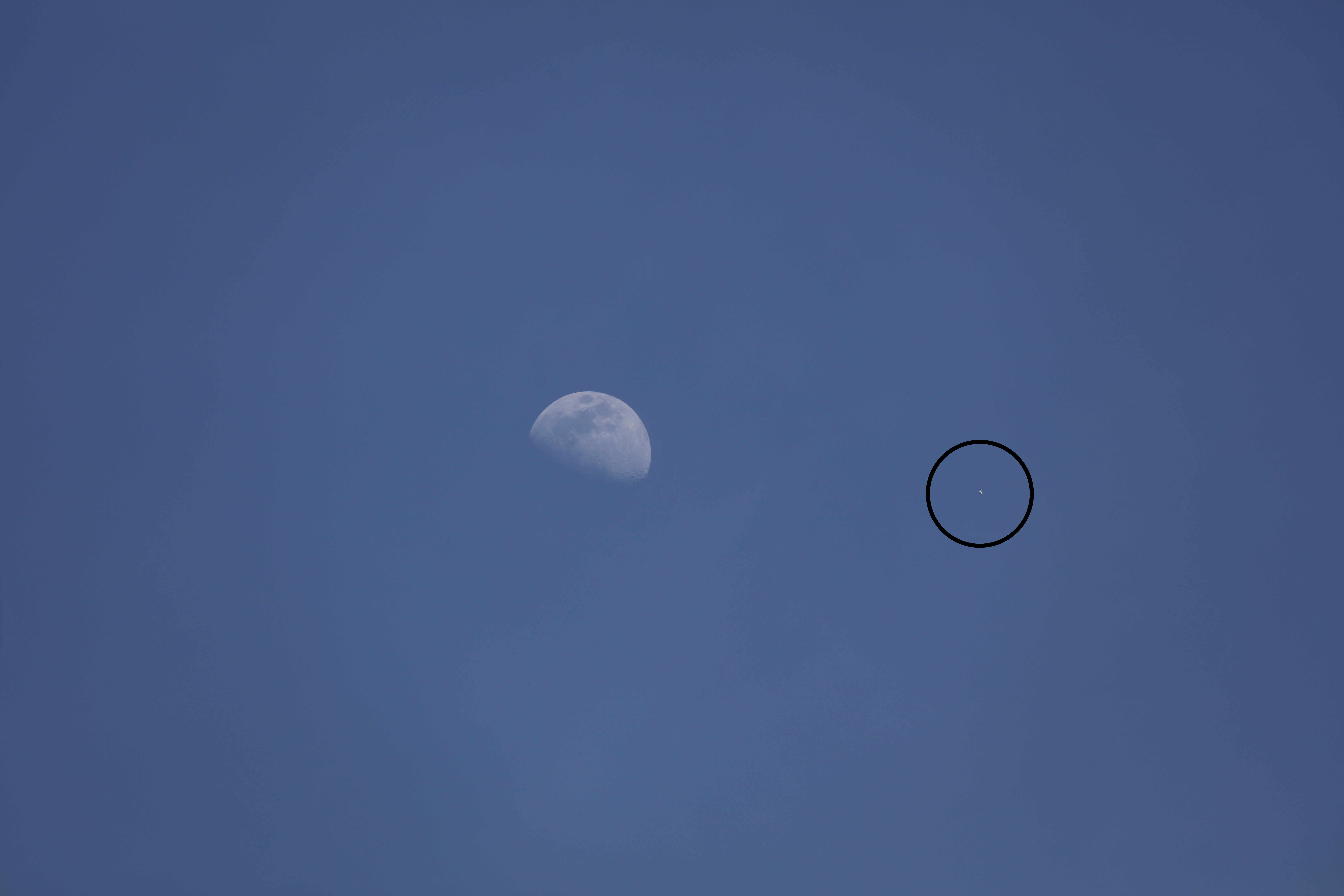
By way of background: The following occurred March 30, 2023 at about 6:21 p.m. EDST in suburban Detroit, Michigan. The camera used was a Canon 5DS with Canon EF 100-400mm 4.5-5.6 L II telephoto zoom lens set at 400mm, maximum magnification.
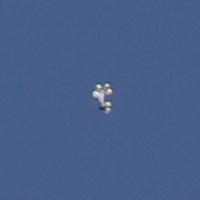
The large photograph shows the position of the waxing gibbous moon, estimated by eye about 40-degrees over the eastern horizon. The tiny object circled above is magnified to 100-percent (full pixel size on the full frame DSLR sensor) in the photo below.
I had been testing the lens’ autofocus system indoors and headed outside to test the lens on far-off subjects. I spotted a half-moon in a beautiful blue sky. As I looked through the viewfinder, I noticed a star-like object moving from the bottom of the frame toward the moon. It looked like one, sometimes two, tiny points of light, moving steadily up the frame, through the sky.
My first thought was, “Wow! An airplane is going to pass in front of the moon! What a shot!” Then, a second thought: “Wait a sec! That tiny thing must be the International Space Station! Holy cat, how lucky!”
Being near-sighted, I could not see the object with my naked eye. My camera has a built-in diopter that adjusts for my vision, enabling me to see sharply when viewing through the eyepiece. The same image that appears as a tiny point near the moon, and magnified full-size above, also appears in the sequence below: the second over in the first row.
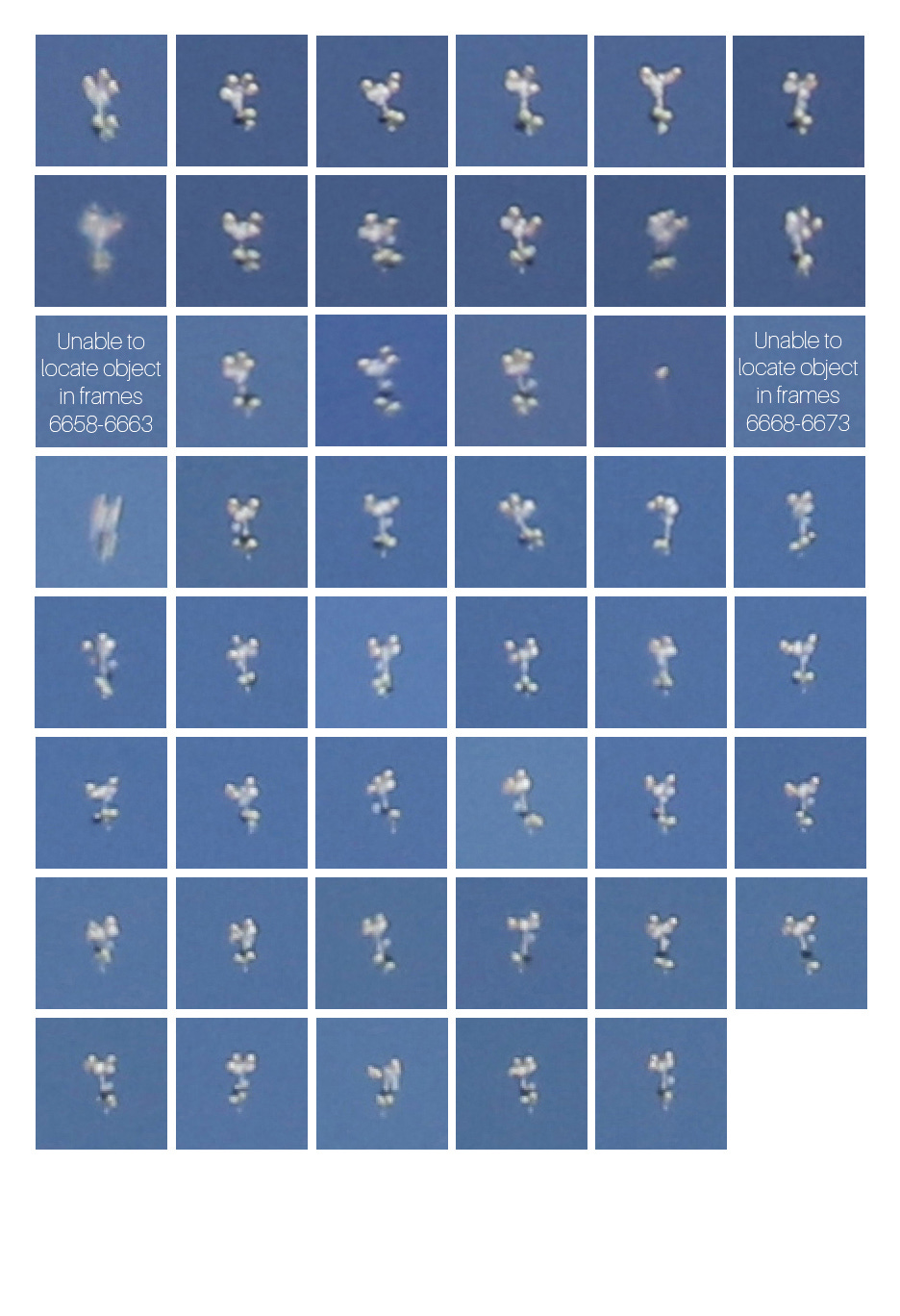
A Stack of Balloons or Not a Stack of Balloons
As I watched and photographed the object, it reversed direction of travel and began to move “down frame,” away from the moon and toward the bottom of the frame. Oh, well, that ruled out the ISS and most air traffic.
Please note how the object seems to change from frame-to-frame, about second-to-second. In the third row, fifth image from the left, an object (unsure if it’s the same one) appears as a single “balloon” trailing a thin twin-tail. It appeared in only one frame, closer to the moon than images made immediately before or after.
Still, the thing “acted” weirdly, seeming to move smoothly for a moment, then quickly to another part of the sky. I tried to keep it in the viewfinder, but lost sight of it at least twice.
In my attempt to capture the image, I took many frames that did not show the object — only blue sky or sky with my neighbor’s home. I reacquired the object through the camera viewfinder and took the final images before again losing the object as it moved east, getting smaller. Eventually, I could not see it at all.
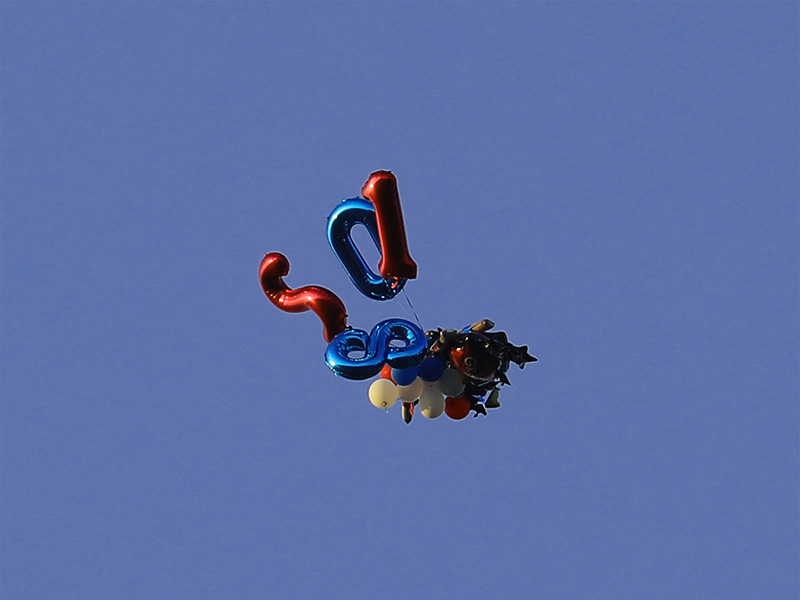
After getting indoors, I began to examine what I’d photographed using the camera’s 3.4-inch screen. At first, upon 100-percent magnifcation, I thought it was a cluster of balloons, similar to ones escaped from a birthday party I’d previously photographed passing by overhead (an example of which is seen at the top of this story).
Closer examination revealed the thing seemed to be a stack of spheres that could change shape, moving spheres and changing positions from image to image. Also, I thought the thing may be “jumping” from one part of the sky to another. In some images, the spheres seem to blur as they change position in the stack.
I still do not know what the object was. While I have photographed other odd objects in the skies, I had not seen anything like it before or since. I am familiar with hundreds of UFO photographs, and only remember one that captured something similar.
A Note on Zola
The French author and journalist made an excellent observation regarding the gap between our subjective selves — our senses, memory, and interpretation — and our objective world and its possibly infinite versions and objects.
Quoted above, Zola’s full sentence reads: “In my opinion you cannot say you have thoroughly seen anything until you have got a photograph of it, revealing a lot of points which otherwise would be unnoticed, and which in most cases could not be distinguished.”
Precisely our situation. We have remarkable brains, capable of observation, making memories, and considering and understanding what we have experienced. We can describe our memories, often in remarkable detail. However, even the most gifted minds are not capable of absolute perfection. Thus our memories are instantly strengthened, re-energized so to speak, when upon seeing an old photograph we are reminded of the unique subject and moment the image represents.
Please let me know your thoughts on this article, as well as the subject in general and the photos in particular. And please forward copies of images you have taken or that you would like to share. With your permission, of course, I would be honored to post them for discussion.
Thanks for reading. Take good care!